DUE
to recent articles in some publications, I felt it was needed
to clear up some of the facts and maybe some of the fiction
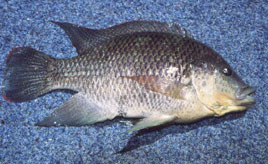
surrounding Tilapia. Commonly referred to the rabbit of Queensland's
waterways Tilapia are part of the Cichlid Family of fishes
and come from the warm, fresh and brackish waters of Africa,
Sri Lanka, Southern India and parts of the Americas.
They
are classified in Queensland as an exotic pest fish and are
declared noxious (meaning harmful and unwholesome to the environment).
There have been over 100 species of cichlids imported into
Australia for the aquarium trade and a few have subsequently
been released into the wild and have established breeding
populations, Tilapia are just one of these. The main three
species are the Mozambique Mouth-brooder (Oreochromis mossambicus)
and the most commonly found, the Convict Cichlid (Cichlasoma
nigrofasciatum) and the Black Mangrove Cichlid (Tilapia mariae),
with the Pearl Cichlid and the Jewel Cichlid being found in
small isolated pockets. Anglers generally refer these to as
Tilapia.
The
Mozambique Mouth-brooder as its name states carries their
eggs in the female's mouth to incubate them for a 3-5 days
period after which they remain there for another 10 - 14 days
after hatching. Although fish that do this don't usually have
many eggs they ensure a high survival rate although they can
breed several times a year. Juveniles may also live for some
time in the female's mouth even after she has died. I have
been told that Tilapia eggs can survive for over a month high
and dry up the bank or in the freezer, only to again be liberated
by rising water levels or the frames used as bait. This is
why Tilapia must never be thrown back into the water or even
put into the crab pots or crayfish traps as bait.
Except
for when they are small these invaders have no natural enemies,
as they can grow too large for native predator fish such as
bass and even cod to eat. Having a strong resistance to diseases
and a high tolerance for salinity and oxygen they thrive in
our warm climate being able to survive between 8 and 42 degrees
Celsius. There have been odd occasions in impoundments where
Tilapia have partially died off after a turn over of the water
during winter with westerly winds causing the temperature
to fall too low for them to survive. A simple requirement
for food means that they can eat almost any thing that is
available and compete directly with Australian native fish
for food and space and even eating the native fishes eggs.
(That is one advantage of being mouth-brooder). Found in habitats
such as impoundments, rivers,
streams, farm dams, artificial drainage channels and the upper
sections of tidal waters, tilapia have the ability to move
from one river system to another.
The
areas where Tilapia have established themselves include Lakes
Wivenhoe, Somerset, Kurwongbah, Tingalpa Reservoir and adjoining
waters in south east Queensland and around Townsville, Innisfail,
Cairns, Port Douglas and Atherton Tablelands in the north.
They have also been recently detected in Boondoomba Dam. There
is also a population in Victoria at the Hazelwood power station
cooling ponds and the creek below. In the United States Tilapias
are a pest as well, but some hybrids have been
put to good use in keeping artificial irrigation drains clean
with some success.
There
are only a few options available to control unwanted invaders.
They include poisons (piscicides) specific to fish as was
used in a Port Douglas pond in 1989 where FIVE (5) fish were
released and turned into over one million fish (18 tonnes)
in three years. The downfall of using this is all fish, invertebrates
and crustaceans in the particular waterway poisoned will be
destroyed.
Another
option is stocking of massive amounts of Australian native
predator fish such as Barramundi, Mary River Cod and Bass
in the hope that they may keep numbers down, noting that tilapia
managed to get a foot hold at lake Wivenhoe SE Qld where there
are literally millions of fork-tailed catfish present (another
mouth-brooder).
The
final option is by catching them. But, under the Fisheries
Act 1994 "it is an offence to bring noxious fisheries resources
(meaning fish) or cause noxious fisheries resources to be
brought into Queensland; or possess, rear, sell or buy noxious
fisheries resources; or relate noxious fisheries resources;
or cause noxious fisheries resources to be placed or released,
into Queensland waters. This includes keeping them in an aquarium
or farm dam. Fines of up to $150 000 can be imposed on anyone
having noxious fish in their possession without a permit.
Noxious fish cannot be kept, hatched, reared or sold. When
caught all noxious fish should be destroyed; they
must not be returned to the water and must not be used as
bait. Anyone releasing noxious fish may be charged with the
cost of eradication and removal of those fish."
It is advised that if any tilapia is caught they should be
buried above the high watermark.
The
plain fact of the matter is that on any given day there are
hundreds of people who go out and target tilapia to eat as
it is held that they are quite edible. They are breaking the
local law and could face the consequences if caught. But it
seems this is the only way that numbers are being kept down.
In saying that, it needs to be emphasised that anyone who
puts tilapia or any noxious fish into a body of water anywhere
is a bloody idiot. I hope this has cleared the water some
in regard to Tilapia. For further inquiries contact your local
Fisheries office.
List
of noxious fish in Queensland.
1- Carp
2- Piranhas
3- Tilapia
4- Walking Catfish
5- Bluegill
6- Electric Eel
7- Grass Carp
8- Largemouth Bass
9- Mosquitofish
10- Nile Perch (alive only)
11- Parasitic Catfish
12- Pike Cichlid
13- Snakehead
14- Tiger Shovelnose Catfish
15- Tigerfish
16- Chinese Weather Loach