Big
bass at Big W ( Lake Wivenhoe ) -
Garry Fitzgerald
SEVERAL
years ago now, Lake Wivenhoe
was the original big bass location in south east Queensland.
Cricket score captures by anglers in the know, and those
that had electric motors on their boats, were common
events particularly during the depths of winter.
At a time when most fishing commentators were claiming
freshwater fish couldn't be caught during the colder
months, Big W was producing big fish in good numbers.
The major rain of early 1999, that saw more rain in
the Brisbane catchment than in '74, changed things a
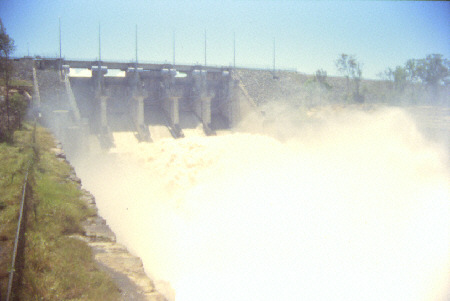
lot. Many of the bass and yellow belly here went "over
the top" when the flood gates were opened for an
extended period.
While
this gave some spectacular fishing down stream around
the Colleges Crossing area (many over night gun anglers
came into being at the time), Lake Wivenhoe and the
upstream Lake Somerset seemed
almost devoid of quality fish compared to previous years,
the turkey shoot was over it seemed.
The limelight for big bass
and yellow belly went to other locations like Lake
Barambah and more recently Lake
Samsonvale and rightly so. Big fish capture the
imagination of anglers everywhere.
With a timely return to winter fishing form, Wivenhoe
is again the talk of many avid fresh water anglers discussions.
Recent captures of plenty of 50cm + bass (between 2.5
and 3 kg) and good numbers of average sized specimens
has seen an upturn in fishing here once again. Some
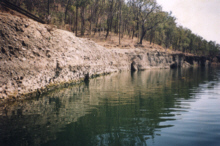
of the tried and true locations such as Billies Bay,
Hamon Cove and Platypus Cliffs are all holding fish.
Many of the bigger fish are scattered around points,
ridge lines and weed lined bays.
As always, Big W is best fished with traditional bibbed
lures as opposed to the current trends of soft plastics,
deep fly & spinnerbaits. This is possibly due to
the big numbers of bony bream and mouth almighty present
here that our predator fish seem to have a penchant
for.
Fishing with bibbed deep divers claimed all of the top
placings at the recent Brisbane Bass Masters Wivenhoe
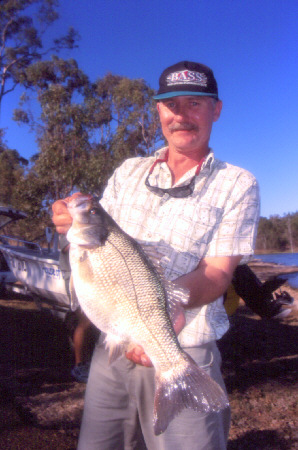
event. International angler Chris Barnett took out first
place with a 50 cm, 2.46kg bass on a deep diving Bill
Norman lure. See below right.
Another food source that is fast become a staple diet
for the bigger fish is redclaw crayfish. Some looking
at stomach contents of fish here recently has revealed
some interesting finds. Big redclaw crayfish, shrimps,
bony bream, mouth almighty, gudgeons and even small
fork tailed catfish have been found.
With
the upsurge in stocking rates here over the past few
years, and extra money from the Stocked Impoundment
Permit (SIP) beginning to filter through the future
looks bright for fishing at Big W.
Fact
File
Wivenhoe takes the name from the town in Britain and
is of Saxon origin, Wiven or Wifa meaning proper name
and Hoe meaning ridge or spur of land.
The potential for Wivenhoe, as a suitable location
for a dam, was recognized in the 1890's as a result
of the great flood in 1893.
Preliminary work and reporting for a proposal to build
a dam at Wivenhoe began in the mid-sixties and the
acquisition of land for the submerged area was commenced
in 1973.
Design investigations were commenced in 1973 and construction
began in 1974.
The dam was completed in 1983 when a minor flood substantially
filled the lake before construction was quite finished
creating the biggest lake in Queensland at that time.
The dam supplies town water to Brisbane and surrounding
regions and also acts as flood mitigation, a necessary
objective after the 1974 Brisbane flood.
The
dam itself has a catchment area of 5700 km²,
has a surface area of 10 800 hectares and holds some
1 165 000 ML of water at an average depth of almost
11 meters.
Fish
After constructed, many fish found themselves trapped
in Lake Wivenhoe.
This provided for some spectacular captures of big
tarpon
and mullet.
The first opening of the flood gates however saw the
last these remnant catadromous fish disappear with
snub nosed gar, fork tailed catfish, eel tailed catfish,
spangled perch and lungfish staying in the lake to
establish breeding populations along with a myriad
of smaller bait fish species.
Since then, over 1 000 000 native fish fingerlings
have been stocked to provide good fishing opportunities
for anglers.
These
stocked fish include bass, yellow
belly, silver perch, Mary River cod and saratoga.
Other species that have been illegally introduced are tilapia,
barred or banded
grunter and redclaw
crayfish.
For better or worse it seems these are here to stay.
Tilapia and redclaw are now a popular target by locals and
tourists alike due to their highly regarded eating qualities.
**
A Stocked Impoundment Permit is required to fish on Lake
Wivenhoe.
Boating
Boating on Lake Wivenhoe is restricted to 4 stroke and direct
fuel injected 2 stroke motors with a speed limit of 6 knots.
Electric motors and paddle craft are also permitted but
no ski boats, tubes, skiing or jetski's are permitted.
It pays to take extra fuel &/or deep cycle batteries
to ensure that you make it home safely. During the summer
months, the afternoon southeast breeze can turn the surface
of Wivenhoe into white caps.
A Seqwater boating permit is required for all trailerable
vessels.
Boating access is from daylight till dark with all access
gates being locked at night except at camping areas for
obvious reasons.
Camping
Camping is permitted at Captain Logan Camp and at Lumley
Hill, booking is essential at times and a camping fee applies.
Toilets, BBQs, public telephone, hot showers, playground,
picnic tables, drinking water, limited firewood, and kiosk
are provided in here.
On the western side of the dam wall is a tourist information
center, on the east at Cormorant Bay is a restaurant and
café.
For
further information contact Lake Wivenhoe Information Center:
Phone 07 5426 1866.